






In traditional software design, tools such as databases, message queues, and caching systems are often treated as distinct and independent categories. At a surface level, they may appear similar—for example, both a database and a queue store data temporarily,but their underlying access patterns, performance expectations, and architectural designs differ significantly.
However, as modern systems evolve, this rigid categorization is becoming increasingly outdated.
The Shift Toward Unified Data Systems
Today’s technology landscape has introduced a wide range of specialized tools designed to solve specific data challenges. These tools are no longer confined to singular roles. Instead, they often overlap in functionality, blurring the lines between traditional system boundaries.
For instance:
- Some data stores now support messaging capabilities.
- Certain streaming platforms provide durability and persistence similar to databases.
This convergence reflects a broader shift: rather than thinking in isolated components, engineers are now required to think in terms of integrated data ecosystems.
From Single Tools to Composable Architectures
Modern applications are no longer simple enough to rely on a single system to handle all data-related needs. As applications scale and become more complex, their requirements expand across multiple dimensions real-time processing, searchability, fault tolerance, and performance optimization.
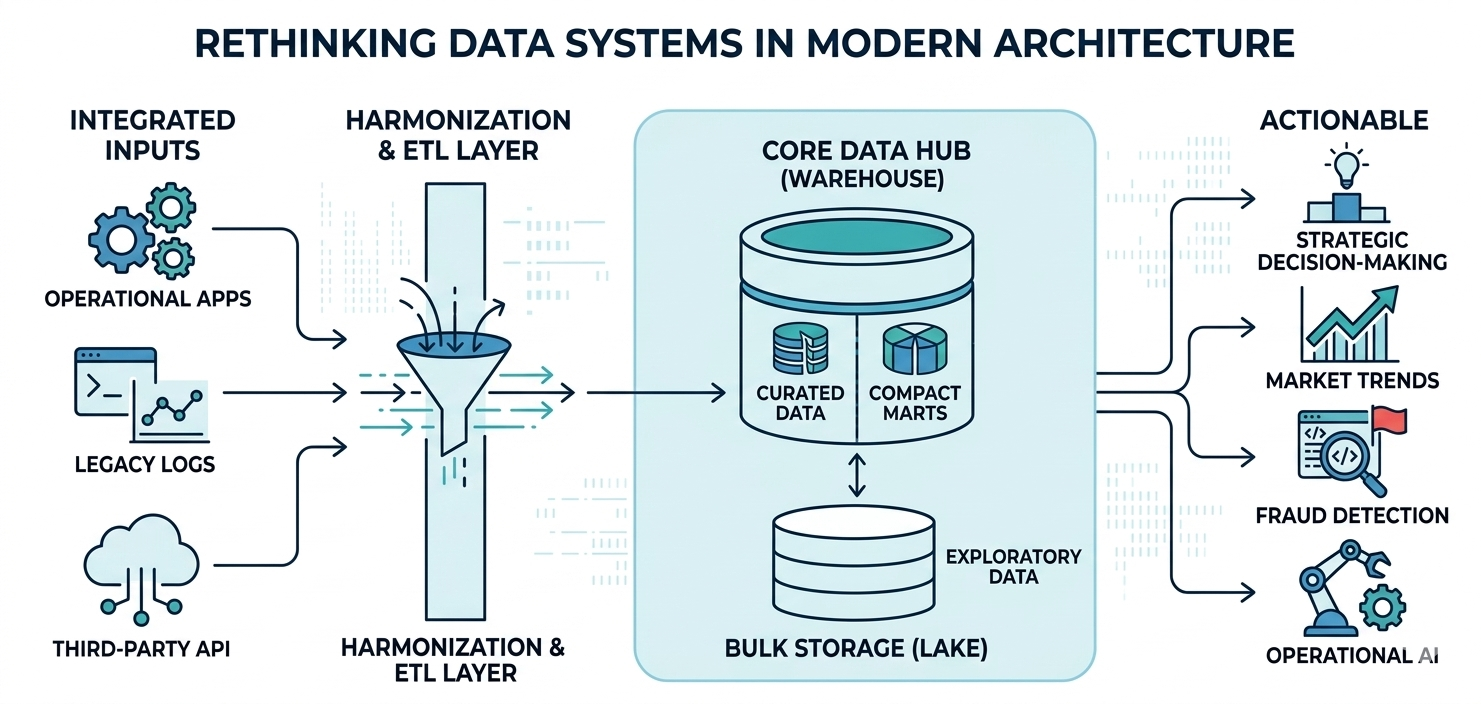
To meet these demands, systems are designed as compositions of multiple specialized tools, each handling a specific responsibility efficiently.
A typical architecture might include:
- A primary database for persistent storage
- A caching layer to improve response times
- A search engine for advanced querying capabilities
- A messaging or streaming system for asynchronous processing
These components do not operate in isolation. Instead, they are orchestrated through application logic, which ensures that data flows correctly and remains consistent across the system.
The Role of the Application Layer
As systems become more distributed, the responsibility of maintaining consistency and coordination increasingly shifts to the application layer. Developers must ensure that:
- Cached data reflects the most recent updates
- Search indexes remain synchronized with source data
- Messages are processed reliably without duplication or loss
In effect, the application itself becomes the glue that binds multiple data technologies together, transforming a collection of tools into a cohesive and functional system.
At this point, the role of a developer extends beyond writing business logic. You are effectively designing a custom data system, tailored to the specific needs of your application.
The Emergence of Composite Data Systems
When multiple tools are combined to deliver a unified service, the result is what can be described as a composite data system. While the internal architecture may involve several moving parts, the external interface typically exposed through APIs—presents a simplified and consistent experience to users.
This abstraction is powerful. It allows clients to interact with a system that appears seamless, while behind the scenes, multiple technologies work together to deliver performance, reliability, and scalability.
However, this added flexibility introduces a new layer of complexity.
Key Challenges in Data System Design
Designing and managing such systems requires careful consideration of several critical factors:
- Data Integrity: Ensuring that information remains accurate and complete, even in the presence of failures or partial system outages.
- Consistency Across Components: Keeping multiple systems—databases, caches, and indexes—in sync without introducing conflicts or stale data.
- Performance Stability: Maintaining predictable response times, even when certain parts of the system are under stress or degraded.
- Scalability: Designing systems that can grow seamlessly as data volume, user demand, and operational complexity increase.
These challenges highlight an important reality: modern data system design is no longer just about choosing the right tools. It is about understanding how those tools interact, and how to orchestrate them effectively.
A New Mindset for Engineers
As the boundaries between technologies continue to blur, engineers must adopt a more holistic approach to system design. Instead of focusing on individual components, the emphasis shifts to:
- System-wide behavior
- Trade-offs between performance, consistency, and cost
- Long-term maintainability and adaptability
This mindset transforms software development into a discipline that combines engineering precision with architectural strategy.
Closing Insight
In today’s data-driven world, building effective systems is less about relying on a single powerful tool and more about assembling the right combination of tools into a cohesive, reliable, and scalable solution.
Those who can navigate this complexity—balancing trade-offs, ensuring consistency, and designing for growth are the ones who build systems that not only work today but remain resilient in the face of tomorrow’s challenges.