






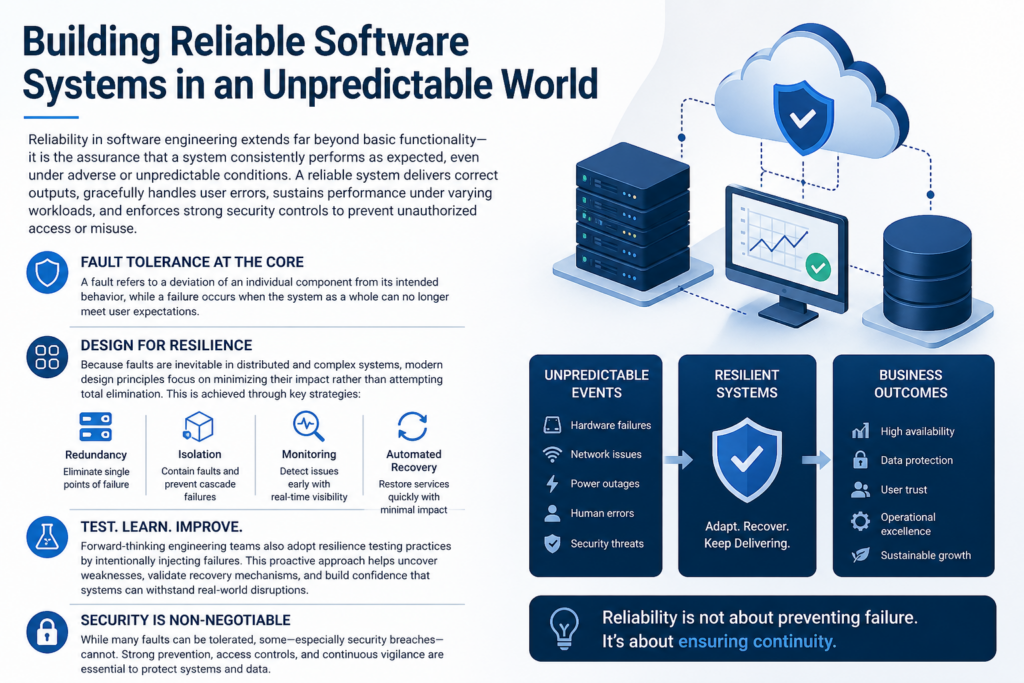
Reliable Software Systems in software engineering is not merely about functionality-it is about ensuring that systems consistently deliver expected outcomes, even in the presence of uncertainty, stress, or unexpected user behavior. A reliable application performs its intended functions accurately, remains responsive under varying workloads, tolerates user mistakes, and enforces strong security measures to prevent misuse or unauthorized access. These attributes collectively define what it means for a system to “work correctly” in real-world conditions
Central to this concept is fault tolerance. A fault occurs when an individual component deviates from its specified behavior, while a failure arises when the system as a whole is unable to meet its required service level. Given the complexity of modern distributed systems, eliminating faults entirely is impractical. Instead, effective system design focuses on preventing faults from escalating into failures. This is achieved through architectural patterns such as redundancy, fault isolation, continuous monitoring, and automated recovery mechanisms that restore normal operations with minimal disruption.
Modern engineering practices also emphasize resilience through controlled experimentation. By deliberately introducing faults-such as simulating server crashes or network interruptions-teams can evaluate how systems respond under pressure. This approach strengthens confidence in the system’s ability to recover gracefully and exposes weaknesses in error-handling logic before they impact users.
However, not all risks can be mitigated through tolerance alone. In areas like security and data protection, prevention is critical, as certain incidents, such as breaches, are irreversible. Ultimately, building reliable systems requires a balanced strategy that combines proactive design, rigorous testing, and continuous improvement to ensure stability, resilience, and trustworthiness in an ever-changing environment.
By following these architectural principles, we ensure our reliable software systems stand the test of time