






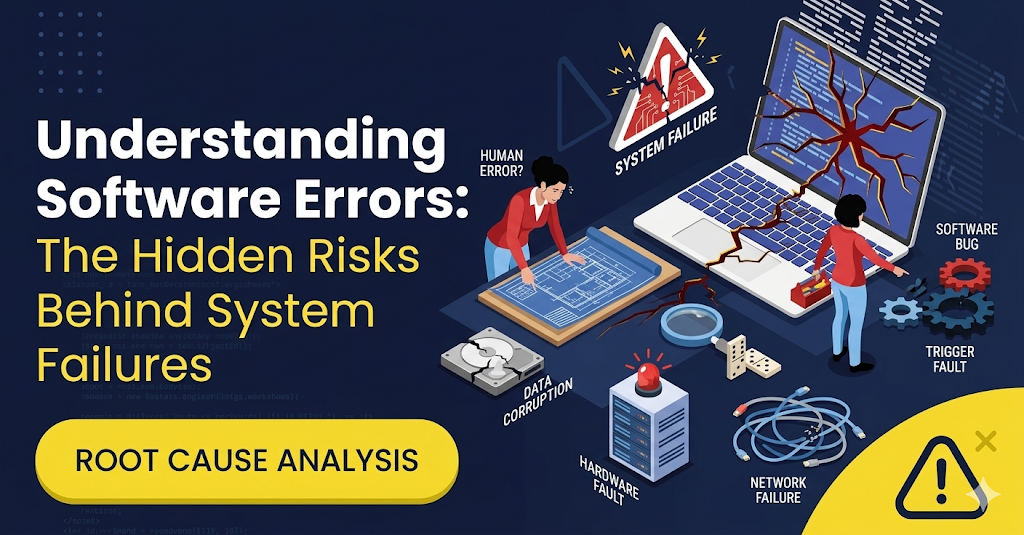
In modern software systems, reliability is often discussed in terms of hardware resilience disk failures, server crashes, or network interruptions. These faults are typically perceived as random and independent events. For example, the failure of one machine’s disk does not necessarily imply that another machine will fail at the same time. While there may be minor correlations due to shared environmental factors such as temperature or power supply, hardware failures are generally isolated and manageable through redundancy and failover strategies.
However, beneath the surface lies a more complex and often more dangerous category of faults: software errors. Unlike hardware faults, software errors are systematic. They arise from flaws in design, logic, or assumptions embedded within the system. Because these faults are often replicated across multiple instances of an application, they can lead to widespread and simultaneous failures, making them significantly more disruptive and harder to predict.
The Nature of Systematic Software Faults
Systematic software faults differ fundamentally from hardware faults in one key aspect: correlation. When a software bug exists in a system, it is usually present everywhere that software runs. This means that under the right conditions, a single issue can cause failures across an entire distributed system simultaneously.
These errors often remain dormant for long periods, hidden within the system until triggered by a specific and often rare set of circumstances. When they do surface, the consequences can be severe, affecting multiple components and potentially leading to cascading failures.
Common Examples of Software Errors
Understanding the types of software errors that can occur is essential for designing resilient systems. Some common examples include:
1. Application-Wide Bugs Triggered by Specific Inputs
A single malformed or unexpected input can cause every instance of an application to fail if the bug is embedded in shared code. A well-known example is the leap second event on June 30, 2012, which exposed a flaw in the Linux kernel. This seemingly minor time adjustment caused numerous systems worldwide to hang simultaneously, demonstrating how a single overlooked edge case can have global consequences.
2. Resource Exhaustion Due to Runaway Processes
Software processes that are not properly controlled can consume excessive system resources such as CPU, memory, disk space, or network bandwidth. When this happens, other components in the system may be starved of resources, leading to degraded performance or complete system failure.
3. Dependency Failures
Modern systems rely heavily on interconnected services. When a dependent service becomes slow, unresponsive, or begins returning corrupted data, it can disrupt the functionality of the entire system. These failures are particularly challenging because they often originate outside the immediate control of the affected application.
4. Cascading Failures
One of the most dangerous types of software faults is the cascading failure. In this scenario, a small issue in one component triggers failures in others, creating a chain reaction. For instance, a slow database might cause application servers to time out, which in turn increases load on retry mechanisms, further overwhelming the system.
The Root Cause: Faulty Assumptions
At the heart of many software errors lies a flawed assumption. Developers often design systems based on conditions that are expected to hold true such as stable network latency, consistent data formats, or predictable user behavior. While these assumptions may be valid most of the time, they inevitably break under certain conditions.
When these assumptions fail, the system may behave unpredictably or collapse entirely. The challenge is that these edge cases are often difficult to foresee during development, especially in complex, distributed environments.
Why Software Errors Are Hard to Eliminate
Unlike hardware faults, which can often be mitigated through redundancy and replacement, software errors require a deeper and more nuanced approach. There is no single solution that can eliminate systematic faults entirely. Instead, building resilient software systems requires a combination of strategies that work together to reduce risk and improve recovery.
Strategies for Building Resilient Systems
To effectively manage software errors, organizations must adopt a proactive and layered approach to system design and operation. Some key practices include:
1. Careful System Design and Assumption Validation
Engineers should explicitly identify and challenge the assumptions their systems rely on. By considering edge cases and failure scenarios during the design phase, it becomes possible to reduce the likelihood of unexpected behavior in production.
2. Comprehensive Testing
Testing should go beyond standard unit and integration tests. Techniques such as stress testing, chaos engineering, and fault injection can help uncover hidden vulnerabilities by simulating real-world failure conditions.
3. Process Isolation
Isolating components within a system ensures that a failure in one part does not bring down the entire application. This can be achieved through containerization, microservices architecture, or sandboxing techniques.
4. Graceful Failure and Recovery Mechanisms
Systems should be designed to handle failures gracefully. Allowing processes to crash and restart automatically can prevent minor issues from escalating into major outages. Techniques such as circuit breakers and retries with backoff can also help manage transient failures.
5. Monitoring and Observability
Continuous monitoring of system behavior is critical for detecting anomalies early. Metrics, logs, and distributed tracing provide valuable insights into system performance and help identify the root causes of failures.
6. Real-Time Consistency Checks
For systems that must uphold strict guarantees such as ensuring that the number of incoming messages matches the number of processed outputs self-checking mechanisms can be implemented. These systems continuously validate their own state and raise alerts when inconsistencies are detected.
Embracing Failure as a Design Principle
One of the most important shifts in modern software engineering is the recognition that failures are inevitable. Instead of attempting to eliminate all possible errors a nearly impossible task engineers should focus on designing systems that can tolerate, detect, and recover from failures efficiently.
This mindset encourages the development of systems that are not only robust but also adaptable. By anticipating failure and planning for it, organizations can minimize downtime, protect user experience, and maintain trust.
Conclusion
Software errors represent one of the most significant challenges in building reliable systems. Unlike hardware faults, they are often systemic, correlated, and capable of causing widespread disruption. Their root cause frequently lies in hidden assumptions that only become visible under rare conditions.
While there is no quick fix for these issues, a combination of thoughtful design, rigorous testing, process isolation, and continuous monitoring can significantly reduce their impact. Ultimately, the goal is not to create perfect systems, but to build systems that are resilient capable of withstanding the unexpected and continuing to deliver value even in the face of failure.
By understanding the nature of software errors and adopting a proactive approach to system reliability, organizations can build technology that is not only functional but truly dependable in an unpredictable world.