






A clear breakdown of front-end vs back-end development, what each involves, the tools and languages used, how they work together, and how to choose the right path for your goals.
Introduction
If you have spent any time exploring web development, you have almost certainly encountered the terms front-end and back-end, and probably full-stack too. These are not just labels; they describe genuinely different disciplines with different skill sets, different tools, different day-to-day work, and different career trajectories. Understanding the distinction clearly is essential for anyone choosing a learning path, building a team, evaluating a product, or simply trying to make sense of how modern web applications are built. This post breaks down both sides of web development thoroughly, what each involves, which technologies each uses, how they interact, and how to decide which direction is right for you.
What Are Front-End and Back-End Development? (Simple Explanation)
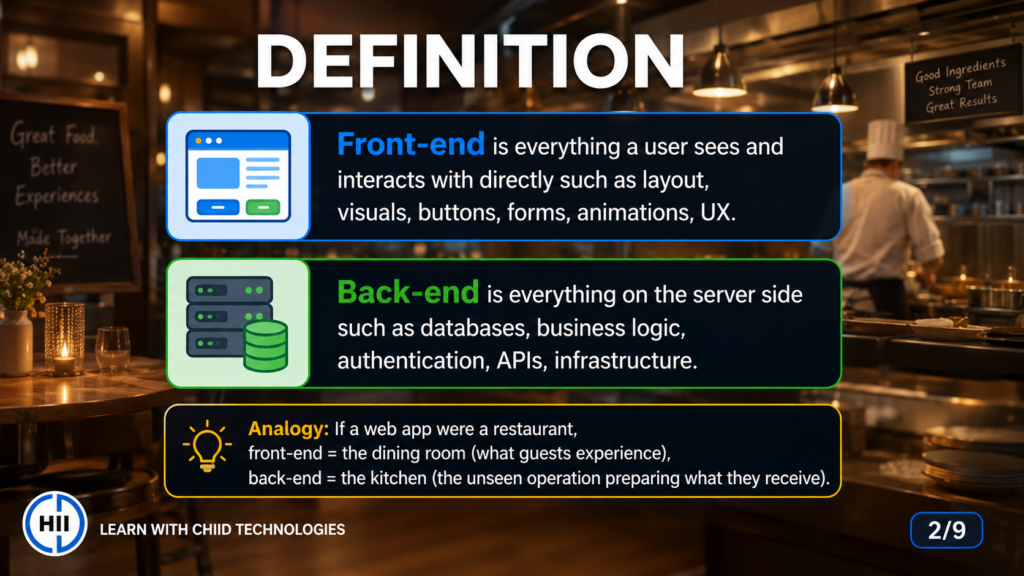
Front-end development covers everything a user sees and directly interacts with in their browser, the layout, the visual design, the buttons, the forms, the animations, and the overall user experience. Back-end development covers everything that happens on the server side, the databases, the business logic, the authentication systems, the APIs, and the infrastructure that the front end communicates with to retrieve and store data. If a web application were a restaurant, the front-end would be the dining room, the environment guests experience directly, and the back-end would be the kitchen, the unseen operation that prepares and delivers what guests receive.
Why It Matters
Choosing between front-end and back-end development is one of the most important decisions a beginner developer faces. The wrong choice, pursuing a path that does not match your interests or working style, leads to frustration and slow progress. The right choice, aligning your learning with your genuine strengths and curiosity, accelerates development significantly. Beyond personal career decisions, understanding the distinction helps product managers scope projects accurately, helps non-technical founders communicate effectively with their teams, and helps anyone evaluating software understand where different types of problems originate.
Key Concepts You Need to Know
Front-End Development in Depth
Front-end developers are responsible for translating design specifications into functional, responsive, accessible web interfaces. Their core technologies are HTML (structure), CSS (styling), and JavaScript (behaviour), the three languages covered in the previous three posts in this series. In professional settings, front-end developers almost always work with a JavaScript framework, React is currently the most widely adopted, followed by Vue and Angular, which provides structured, reusable components and efficient ways to manage complex user interfaces.
Front-end developers must also understand responsive design (ensuring interfaces work across screen sizes), web accessibility (ensuring interfaces are usable by people with disabilities), browser compatibility (ensuring consistent behaviour across different browsers), and performance optimisation (ensuring pages load quickly). They collaborate closely with UI/UX designers, often working directly from design files in tools like Figma, and with back-end developers to integrate APIs.
Back-End Development in Depth
Back-end developers build and maintain the server-side systems that power web applications. Their responsibilities include designing and managing databases (using SQL databases like PostgreSQL or MySQL, or NoSQL databases like MongoDB), building APIs (Application Programming Interfaces) that allow the front end to request and receive data, implementing authentication and authorisation systems (controlling who can log in and what they can access), writing business logic (the rules that govern how the application behaves), and managing server infrastructure (either on physical servers or cloud platforms like AWS, Azure, or Google Cloud).
Back-end developers work in a wide range of languages, Python (often with the Django or Flask frameworks), JavaScript via Node.js (with Express), Ruby (with Rails), PHP (with Laravel), Java (with Spring), and Go are all common. The choice of language is often determined by the organisation’s existing technology stack rather than by individual preference.
How Front-End and Back-End Work Together
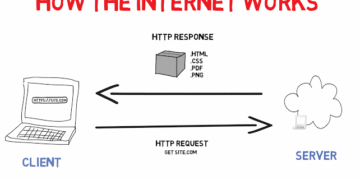
In a modern web application, the front end and back end communicate through APIs, typically REST APIs or GraphQL APIs. When a user performs an action on the front end (submitting a login form, searching for a product, placing an order), the front end sends an HTTP request to the back end. The back end processes the request, querying a database, applying business rules, validating data, and returns a response, usually in JSON format. The front end receives that response and updates the user interface accordingly. This separation of concerns (the front end handles presentation; the back end handles data and logic) is what makes modern web applications scalable, maintainable, and flexible.
Full-Stack Development, The Third Path
Full-stack developers work across both front-end and back-end disciplines. The appeal of full-stack development is versatility, a full-stack developer can build a complete feature or even a complete application independently, which is particularly valuable in startups and freelance contexts. The trade-off is depth: full-stack developers are rarely as specialised as dedicated front-end or back-end developers, and as applications grow in complexity, specialist expertise becomes increasingly important. Full-stack development is often the most practical starting point for self-taught developers and bootcamp graduates, with specialisation coming later as experience and context develop.
Choosing Your Path
Several factors are useful in deciding between front-end and back-end development. Front-end development tends to suit people who are visually oriented, enjoy seeing immediate results, are interested in user experience and design, and find satisfaction in building things people interact with directly. Back-end development tends to suit people who enjoy logic and problem-solving, are comfortable with abstract systems, find data and infrastructure interesting, and prefer working on challenges that are less visible but architecturally significant. Neither path is more prestigious or more lucrative than the other, both are in high demand and both offer strong career trajectories.
Common Mistakes or Misconceptions
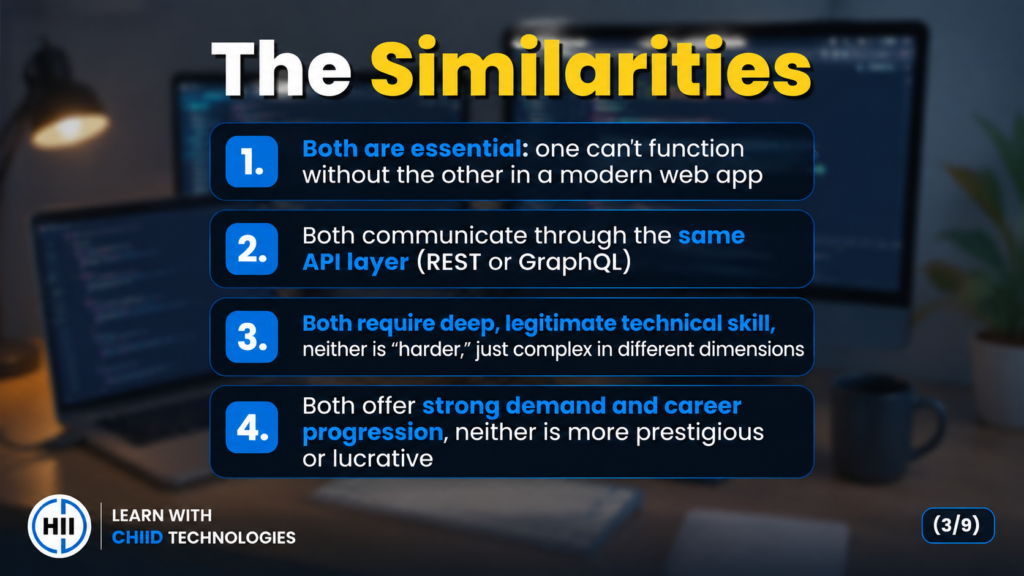
- “Back-end development is harder than front-end.” Both disciplines have significant complexity, just in different dimensions. Front-end complexity lies in browser compatibility, responsive design, accessibility, and performance optimisation. Back-end complexity lies in database design, security, scalability, and systems architecture. Calling one harder than the other reflects personal preference more than objective difficulty.
- “I need to learn both before I can get a job.” Most junior developer roles are clearly designated as either front-end or back-end. Starting with one and developing genuine depth in it is a far more effective path to employment than spreading learning thinly across both. Full-stack competency typically develops over time, after establishing a foundation in one area.
- “The front end is just design.” Front-end development and visual design are distinct disciplines. Designers create the visual language, layouts, and user experience specifications. Front-end developers implement those specifications in code, a process that requires significant technical skill, particularly as the complexity of the user interface increases.
Practical Next Steps
Clarify your direction and start building in the right area with these steps:
- Spend one week building something purely front-end, a responsive webpage with interactive elements using HTML, CSS, and JavaScript. Then spend one week working through a back-end tutorial, building a simple REST API with Node.js and Express, or a basic web app with Python and Flask. Note which felt more engaging and natural, that signal is worth taking seriously.
- Review the job postings in your target market for both front-end and back-end junior roles, compare the required skills, the listed responsibilities, and the salary ranges. This grounds your decision in the actual landscape of opportunities rather than abstract preferences.
- Regardless of which path you choose, learn the basics of Git and GitHub immediately, version control is used by every developer in every role, and being comfortable with it is a baseline expectation for any professional development position.
Key Takeaways
- Front-end development covers what users see and interact with; back-end development covers the server-side logic, databases, and APIs that power the application.
- The two sides communicate through APIs, typically REST or GraphQL, with the front end sending requests and the back end processing them and returning data.
- Full-stack development combines both disciplines and is a common starting point, with specialisation typically developing with experience.
- Choosing between front-end and back-end is most effectively guided by genuine interest and working style, both paths offer strong demand and career progression.
Related Reading
- Previous post: What Web Developers Actually Do
- Coming up next: Responsive Design for Modern Websites
Call to Action: Subscribe for next week’s post, a practical guide to responsive design, the techniques that make websites look and work beautifully on every device from a small smartphone to a large desktop monitor.