







A clear, honest look at what web developers actually do day to day, the different roles, tools, workflows, and realities of a career in web development explained for beginners and career changers.
Introduction
Web development is one of the most talked-about career paths in technology, but most descriptions of it are either too vague (“they build websites”) or too technical to be useful for someone just starting out. The reality of a web developer’s day-to-day work is more nuanced, more collaborative, and more varied than most people expect. There are different types of web developers working on very different things, using different tools, in very different environments. This post gives you an honest, grounded picture of what web development actually involves, the roles, the workflows, the tools, the challenges, and what it really takes to succeed in the field. Whether you are considering web development as a career or simply want to understand the people building the digital world around you, this post gives you the full picture.
What Is Web Development? (Simple Explanation)
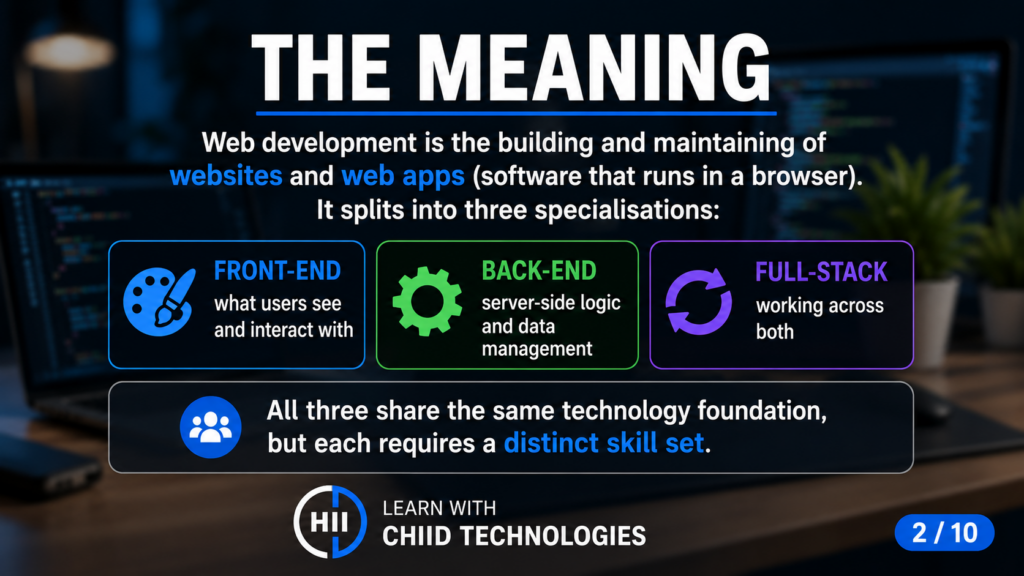
Web development is the work involved in building and maintaining websites and web applications, the software that runs in a browser. It encompasses everything from a simple personal blog to a complex platform serving millions of users simultaneously. Web development is typically divided into three broad specialisations: front-end development (what users see and interact with), back-end development (the server-side logic and data management that powers the application), and full-stack development (working across both). Each specialisation requires a different skill set, though all three share a common foundation in the technologies and principles covered throughout this series.
Why It Matters
Web development is one of the most in-demand and well-compensated skill sets in the global economy. As businesses of every size and type depend on web-based products, services, and communication, the demand for skilled web developers consistently outpaces supply. Understanding what web developers do helps you make informed decisions about whether to pursue it as a career, how to work more effectively with development teams if you are in a non-technical role, and how to evaluate the technical aspects of digital products you use or manage.
Key Concepts You Need to Know
Front-End Development
Front-end developers build the parts of a website or application that users directly interact with, the visual layout, the navigation, the forms, the animations, and the overall user experience. They work primarily with HTML, CSS, and JavaScript, and typically use front-end frameworks like React, Vue, or Angular to build complex, dynamic interfaces efficiently. Front-end developers collaborate closely with designers to translate visual mockups into functional, responsive, accessible web interfaces. Their work is immediately visible, every button, menu, and page layout is the result of front-end development.
Back-End Development
Back-end developers build and maintain the server-side infrastructure that powers web applications, the databases, APIs, authentication systems, and business logic that operate behind the scenes. When you log into an account, place an order, or retrieve a personalised feed, back-end systems are processing your request, querying databases, applying business rules, and returning the right response. Back-end developers work with server-side languages such as Python, Node.js, Ruby, PHP, Java, or Go, along with databases (SQL and NoSQL), cloud infrastructure, and API design. Their work is invisible to end users but essential to everything the front end displays.
Full-Stack Development
Full-stack developers work across both front-end and back-end disciplines, capable of building a complete web application from the user interface through to the server and database. Full-stack development does not necessarily mean equal depth in both areas; most full-stack developers have stronger skills in one domain. The role is particularly valued in startups and small teams where versatility is more practical than deep specialisation, and in freelance work where a single developer may be responsible for an entire project.
The Daily Reality of a Web Developer
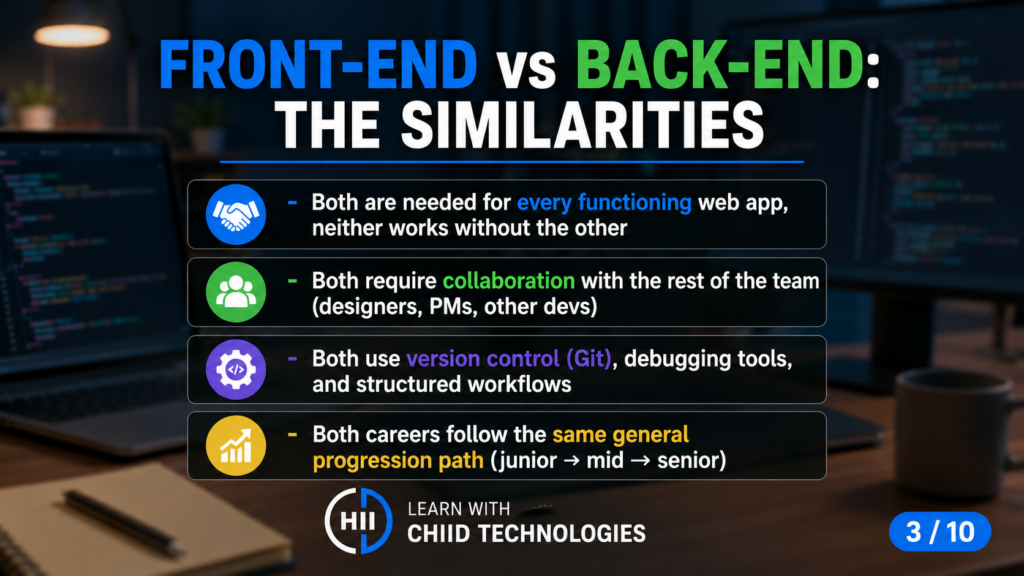
Contrary to the image of a lone developer typing furiously in a dark room, most professional web development is a highly collaborative activity. Developers attend planning meetings, participate in code reviews (where team members examine each other’s code for quality and correctness), write documentation, communicate with designers and product managers, troubleshoot reported bugs, and respond to changing requirements. Actual coding, writing new code, often represents only a portion of the working day. Problem-solving, communication, and adaptability are as important as technical skill.
Tools Web Developers Use Daily
The professional web developer’s toolkit extends well beyond a text editor. Version control with Git (and platforms like GitHub or GitLab) is used to track changes, collaborate with teammates, and manage code history. Package managers like npm install and manage the libraries and frameworks a project depends on. Browser developer tools are used constantly for debugging and testing. Design tools like Figma are used to review and implement visual specifications. Project management tools like Jira, Linear, or Trello track tasks and progress. Command-line interfaces are used to run scripts, manage servers, and interact with development tools. Familiarity with this broader toolkit is what distinguishes a job-ready developer from someone who can write code but cannot yet work in a professional environment.
Career Paths and Progression
Web development careers typically progress from junior developer (learning the codebase and working on well-defined tasks under supervision) through mid-level developer (working independently on significant features and beginning to mentor others) to senior developer (leading technical decisions, designing systems, and mentoring junior team members). Beyond individual contributor roles, experienced developers may move into technical lead, engineering manager, or solutions architect positions. Freelancing and founding technology companies are also common paths for experienced web developers.
Common Mistakes or Misconceptions
- “Web developers just make things look nice.” Visual design is the work of UI/UX designers, not developers. Developers implement designs, translating visual specifications into functional code. The two disciplines overlap in front-end development but are distinct professions with different skill sets and tools.
- “You need a computer science degree to become a web developer.” Web development is one of the most accessible technical careers for self-taught and bootcamp-trained professionals. Employers in most organisations care far more about demonstrated ability, a portfolio of real projects, than formal qualifications. That said, a computer science background provides valuable depth in algorithms, data structures, and systems thinking that becomes increasingly relevant as careers progress.
- “Once you learn one framework, you know them all.” Frameworks share concepts but differ significantly in philosophy, syntax, and ecosystem. React, Vue, and Angular each have distinct mental models. The underlying JavaScript knowledge transfers; the frameworks themselves each require dedicated learning.
Practical Next Steps
Build your understanding of web development as a profession with these steps:
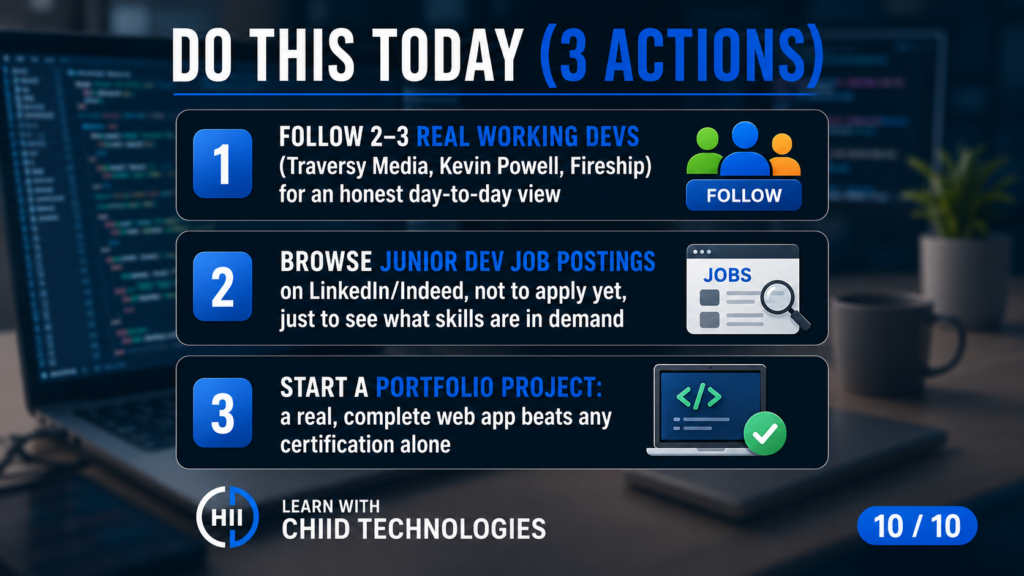
- Follow two or three working web developers on platforms like YouTube, LinkedIn, or personal blogs, people like Traversy Media, Kevin Powell, or Fireship provide an honest, day-to-day view of professional web development that no course can replicate.
- Explore job postings for junior web developer roles on LinkedIn or Indeed, not to apply yet, but to understand what technologies and skills are most commonly required in your target market, and use that information to guide your learning priorities.
- Start building a portfolio project, a real, complete web application with a front end, some interactivity, and if possible a back end or API integration. A portfolio of two or three polished, functional projects demonstrates more to employers than any certification alone.
Key Takeaways
- Web development is divided into front-end (user interface), back-end (server and data), and full-stack (both) specialisations, each requiring a different but overlapping skill set.
- Professional web development is a highly collaborative discipline, communication, code review, documentation, and teamwork are as important as the ability to write code.
- The professional toolkit extends well beyond writing code, version control, package managers, browser dev tools, and project management platforms are all part of daily work.
- Portfolio projects and demonstrated ability carry more weight in web development hiring than formal qualifications, making it one of the most accessible technical career paths for self-taught learners.
Related Reading
- Previous post: JavaScript Basics Every Beginner Should Learn
- Coming up next: Front-End vs Back-End Development
Call to Action: Subscribe for next week’s post, a deeper dive into the front-end versus back-end distinction, what each role involves in practice, and how to decide which path is the right fit for your skills and interests.