





Figure 4.7
The internet is entering a new phase – one where software no longer waits for instructions.
For years, digital technology has revolved around interaction. Humans click buttons, open applications, type prompts, search manually, and navigate workflows step by step. Even the most advanced software systems still largely depend on direct human input to operate.
But AI agents are beginning to change that model entirely.
Unlike traditional AI assistants that simply respond to prompts, AI agents are designed to act. They can plan tasks, make decisions, use tools, execute workflows, retrieve information, and complete multi-step objectives with minimal human intervention.
And that may become one of the most important technology shifts of the decade.
From enterprise automation and software development to research, customer service, productivity, cybersecurity, and digital operations, AI agents are rapidly becoming the next major frontier in artificial intelligence.
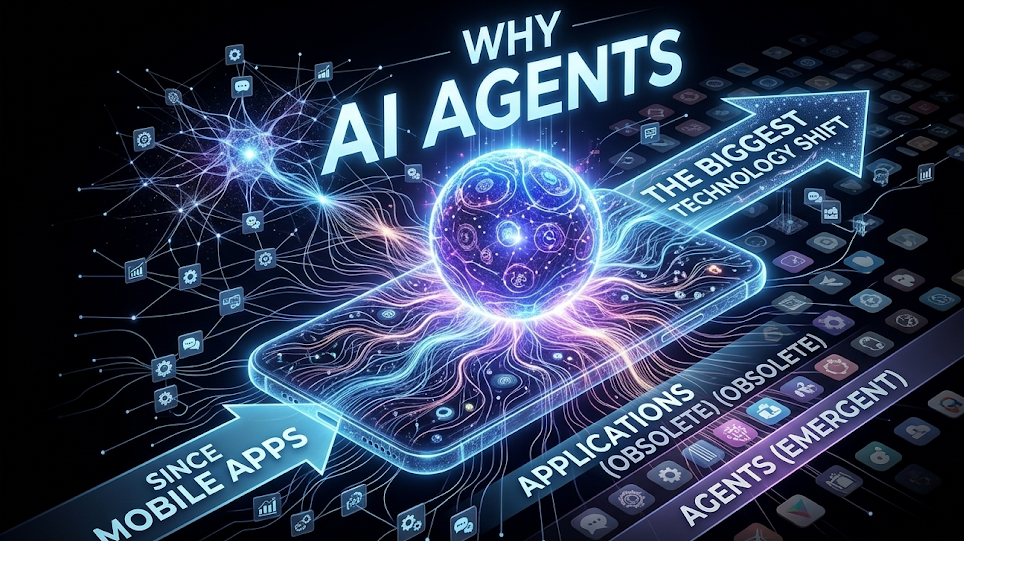
The world is moving from AI that answers questions → AI that performs actions.
What Exactly Are AI Agents?
Most people interact with AI today through chat interfaces.
You type a question.
The system responds.
The interaction ends.
AI agents operate differently.
Instead of functioning like passive assistants, agents are designed to pursue goals autonomously.
An AI agent can:
- Research information across multiple sources
- Analyze data
- Use external tools and APIs
- Make decisions based on changing conditions
- Automate repetitive workflows
- Execute multi-step tasks continuously
Rather than simply generating responses, agents can operate more like digital workers.
This is why many technology leaders believe AI agents could eventually become the interface layer for much of the internet itself.
The Shift From Software Tools to Digital Teammates
One of the biggest implications of AI agents is how they change the relationship between humans and software.
Traditional software requires users to manage every step manually.
AI agents reduce that operational burden.
Imagine telling an AI system:
“Research competitors, summarize industry trends, prepare a presentation outline, schedule a meeting, and draft a follow-up email.”
Instead of switching between multiple apps and tabs manually, the agent coordinates the workflow itself.
This is not simply automation in the traditional sense.
It is intelligence-driven task orchestration.
And it could fundamentally redefine productivity.
Why Big Tech Is Racing Toward Agentic AI
The growing interest in AI agents explains why nearly every major technology company is aggressively investing in agentic systems.
OpenAI, Google, Microsoft, Anthropic, Meta, and several fast-growing startups are all competing to build increasingly autonomous AI ecosystems.
The reason is simple:
Whoever controls the agent layer could influence how people interact with software, information, commerce, and digital services altogether.
This shift is already becoming visible across the industry.
As explored in Why AI Browsers Could Become the Next Big Battle in Tech, browsers themselves are beginning to evolve into intelligent environments capable of understanding context and automating workflows.
At the same time, operating systems are becoming increasingly intelligence-driven. In Why AI Operating Systems Could Redefine Personal Computing, we explored how AI-native computing environments may transform devices from passive tools into adaptive digital ecosystems.
AI agents sit at the center of this transformation.
They are becoming the connective layer between users, software, devices, and workflows.
The Enterprise Opportunity Is Massive
Businesses may experience some of the biggest changes from AI agents.
Across industries, organizations spend enormous amounts of time on repetitive operational tasks:
- Scheduling
- Reporting
- Data entry
- Customer support
- Internal coordination
- Workflow management
- Information retrieval
AI agents could reduce much of this friction.
This is why companies are increasingly experimenting with AI-powered digital workers capable of handling routine tasks autonomously.
For enterprises, the opportunity is not simply cost reduction.
It is operational acceleration.
Organizations may soon operate with hybrid workforces consisting of both humans and AI-driven agents collaborating together continuously.
Software Engineering Is Already Changing
Developers are also beginning to experience the rise of agentic systems directly.
AI coding assistants have already accelerated software development workflows significantly. But the next phase may involve agents capable of:
- Debugging systems autonomously
- Running tests continuously
- Monitoring infrastructure
- Refactoring codebases
- Managing deployment workflows
- Coordinating development pipelines
The role of engineers may increasingly shift from manually executing tasks toward supervising intelligent systems capable of handling portions of software operations independently.
This aligns closely with another major trend explored in Why the Future of Work Will Belong to People Who Can Work With AI, Not Against It.
The future workforce may not be defined by humans competing against AI systems.
It may be defined by humans learning how to collaborate effectively with them.
The Risks Behind Autonomous AI
Of course, more autonomy also creates more risk.
The more capable AI agents become, the more important questions emerge around:
- Security
- Oversight
- Reliability
- Bias
- Data privacy
- Accountability
- Decision-making transparency
An AI agent capable of taking actions autonomously also has the potential to make mistakes autonomously.
This creates enormous responsibility for developers, companies, and policymakers building the next generation of AI systems.
Trust may ultimately become one of the most important competitive advantages in the AI era.
Because intelligence without governance can quickly become dangerous.
The Internet May Never Work the Same Way Again
Every major technology era changes how humans interact with digital systems.
The web browser changed access to information.
Smartphones changed accessibility.
Cloud computing changed infrastructure.
AI agents may change execution itself.
Instead of humans manually coordinating every digital task, intelligent systems may increasingly coordinate tasks on behalf of humans.
That changes software.
That changes productivity.
And eventually, that could change the structure of digital work entirely.
The rise of AI agents is not just another feature trend.
It may represent the beginning of a fundamentally different relationship between humans, software, and the internet itself.
Key Takeaways
- AI agents are evolving from passive assistants into autonomous digital workers
- The next AI wave focuses on action and execution, not just conversation
- Browsers and operating systems are becoming increasingly agent-driven
- Businesses could experience major productivity transformation through AI agents
- Software engineering workflows are already shifting toward AI-assisted operations
- Trust, governance, and security will become critical in autonomous AI systems
- AI agents could redefine how humans interact with software entirely
The first generation of AI helped humans find information faster.
The next generation may help humans get work done entirely differently.
And that shift could reshape the digital world far faster than most people expect.
Read more AI analysis, future-of-work insights, and technology trends on ChiidTech.