






Claude AI went down globally on June 2, 2026, locking out thousands of users and developers. Here’s a full breakdown of what happened and why it matters.
INTRODUCTION
On the morning of June 2, 2026, something every AI-dependent professional dreads happened: Claude went dark.
Anthropic’s widely used AI assistant — a tool that millions of developers, content creators, researchers, and business teams rely on daily — suffered a major global outage. Within hours, thousands of users flooded Downdetector with reports, and social media lit up with frustration and nervous jokes. The disruption wasn’t limited to casual users; it cascaded through APIs, developer consoles, and third-party applications that run on Claude’s backbone.
So what exactly happened? Who was affected? And what does this tell us about the current state of AI infrastructure reliability?
Let’s break it all down.
What Went Down — and When

According to Anthropic’s official status page, the incident began around 6:04 AM UTC on June 2, with the company posting its first “Investigating” update at 6:39 AM UTC. By 9:33 AM UTC, the root cause had been identified, and by 11:49 AM UTC, Anthropic confirmed a fix was in place and being monitored.
The total disruption window ran for approximately two hours and 45 minutes for the most severely affected services — a significant stretch for a mission-critical AI platform.
The primary culprit, according to Anthropic’s status updates, was elevated errors on Claude Opus 4.6, the company’s flagship model, which triggered a cascade of failures across interconnected services.
Who and What Was Affected
The outage was remarkably broad in scope. Anthropic confirmed that the following services experienced elevated error rates or full disruption:
- Claude.ai — the main consumer chat interface (web and mobile)
- Claude Console — the developer dashboard used to manage API keys and usage
- Claude API — the backend service powering third-party integrations
- Claude Code — Anthropic’s specialized coding assistant
Roughly 62% of Downdetector complaints pointed to users being completely locked out of the main website interface, with additional clusters of reports focused on the desktop and mobile apps. Developers were hit particularly hard: with the API throwing errors, any application, workflow, or product built on top of Claude effectively broke alongside it — a textbook domino effect.
Users across X (formerly Twitter) and Reddit reported blank responses, heavy lag, and login failures throughout the outage window.
Anthropic’s Response
Anthropic moved through its incident playbook methodically. The company’s engineering team progressed through four public status updates — Investigating → Update → Identified → Monitoring — before finally resolving the incident.
In a statement to Mashable, Anthropic confirmed:
“Claude is currently unavailable on our consumer-facing surfaces such as claude.ai and our apps. The Claude API that powers businesses remains unaffected. Our team is working to restore full service and we’ll share updates as we have them.”
That API carveout is worth noting: Anthropic maintained that its core API infrastructure stayed operational for part of the outage, which would have provided some continued access for developers running highly integrated setups. However, numerous reports from the developer community suggested that API access was also intermittently disrupted during the peak of the incident.
Service was ultimately fully restored later that morning. Anthropic said in a follow-up statement: “Claude is back up and running across claude.ai and our apps. We’re grateful to our users as the team works to match the incredible demand we’ve seen for Claude in recent days.”
The Bigger Picture: Timing and Context
This outage didn’t happen in a vacuum.
In the days immediately preceding June 2, Claude had surged to the top of the App Store charts, overtaking rival ChatGPT — a milestone driven in part by heightened public attention around Anthropic’s fraught negotiations with the U.S. Department of Defense. That sudden spike in users almost certainly contributed to the infrastructure strain that preceded the outage.
Claude had also experienced earlier disruption on June 1, when Anthropic logged degraded performance for Claude Sonnet 4.6 — suggesting the platform was already under pressure heading into June 2.
This context matters for enterprise decision-makers and developers: a rapid influx of users, combined with ongoing infrastructure demands, can stress even well-resourced AI platforms.
What This Means for AI Reliability
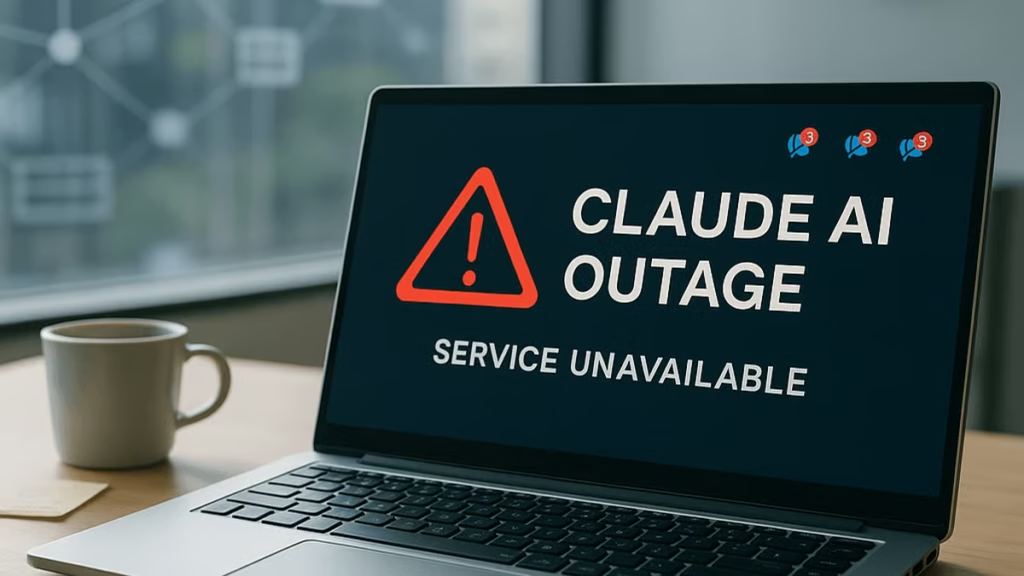
The June 2 outage is a reminder that AI tools — however sophisticated — run on infrastructure that is vulnerable to the same failure modes as any other internet service.
For individual users, the lesson is relatively low-stakes: have a backup AI tool (ChatGPT, Gemini, Mistral) bookmarked for moments when your primary platform goes dark.
For developers and businesses building on top of AI APIs, the stakes are significantly higher. A multi-hour API outage can mean broken customer-facing products, failed automated workflows, and scrambled delivery timelines. This is the core argument for multi-model resilience — architect your AI-dependent systems to gracefully degrade or reroute to a secondary provider when a primary service goes down.
Enterprise procurement teams evaluating AI platforms should factor in historical uptime, incident response transparency, and SLA commitments as core selection criteria — not just model capability benchmarks.
Key Takeaways
- The outage lasted approximately 2 hours and 45 minutes, starting around 6:04 AM UTC on June 2, 2026.
- It affected Claude.ai, Claude Code, Claude Console, and the Claude API, with the root cause tied to elevated errors on Claude Opus 4.6.
- Over 2,000 users reported issues on Downdetector at peak, with the disruption felt globally.
- Anthropic restored full service and credited unprecedented recent demand as contributing context.
- For professionals and enterprises, this highlights the importance of AI redundancy planning as a core infrastructure strategy.
CONCLUSION
Major outages are unwelcome, but they’re a reality of operating at the scale Anthropic now operates at. What matters most is how quickly and transparently a company responds — and on that front, Anthropic’s public status communication was timely and clear.
If you’re a developer or business that relies heavily on Claude, today is a good day to review your resilience strategy. And if you’re evaluating AI platforms for the first time, let this be a reminder that uptime history and incident transparency are just as important as benchmark scores.
Have questions about building AI-resilient workflows, or want to see how AI platforms compare on reliability? Read more on our blog — and drop your thoughts in the comments below.