







Figure1
Evolvability: Designing Systems That Adapt to Change
Change is the only constant in software engineering. The systems that survive and thrive aren’t the ones built perfectly on day one they’re the ones designed to keep getting better long after deployment.
System Architecture • 12 min read • Engineering Fundamentals
No matter how carefully a system is designed, it is extremely unlikely that its requirements will remain the same over time. Businesses evolve, technologies shift, regulations change, user expectations grow, and entirely new use cases emerge unexpectedly. This is why evolvability, the ease with which a system can be modified, extended, and improved over time is one of the most critical characteristics of modern software.
A system that cannot evolve eventually becomes difficult to maintain, expensive to modify, and incapable of supporting future business needs. In rapidly changing environments, the ability to adapt is often more valuable than optimizing for a fixed set of assumptions.
Why Change Is Inevitable
Software systems don’t exist in a vacuum. They live inside organizations, markets, and technological ecosystems all of which are constantly shifting. Over time, every system faces pressure from multiple directions simultaneously.
Common Sources of Change
- Businesses introduce new priorities and strategic pivots
- Customers request additional features and expect better experiences
- Legal and compliance requirements evolve sometimes without warning
- New platforms and technologies create integration demands
- Infrastructure requirements scale up unexpectedly
- Security expectations become increasingly strict
Even systems that begin with crystal clear requirements eventually face scenarios their original designers never anticipated. A startup application built for a few thousand users may suddenly need to support millions. A platform designed for web may need mobile or AI integrations. A local product may go global, requiring localization, compliance infrastructure, and distributed architecture.
“The systems that succeed aren’t necessarily the ones that are perfect on day one they’re the ones designed to keep improving long after deployment.”
The Agile Connection
Modern agile development practices exist largely because change is unavoidable. Agile methodologies emphasize continuous iteration, incremental delivery, fast feedback loops, and adaptability to changing requirements. These aren’t just workflow preferences they’re a direct response to the reality that software requirements are discovered over time, not defined upfront.
The technical practices that support agile work Test Driven Development (TDD), Continuous Integration and Deployment (CI/CD), refactoring, and automated testing all serve the same underlying goal: making systems easier to change safely. They help engineering teams avoid rigid architectures that become obstacles to future development rather than foundations for it.
Beyond the Codebase: System Level Evolvability
Most discussions about agility focus on small scale code changes within a single application. But true evolvability becomes significantly more challenging and more important at the level of large distributed systems.
Modern applications often consist of multiple services, distributed databases, APIs and integrations, event driven architectures, and cloud infrastructure components. Making architectural changes across these systems requires a fundamentally different approach.
Example Scenario
Migrating from a monolithic architecture to microservices isn’t just a code refactor; it means redefining team ownership, redesigning data boundaries, managing distributed consistency, and often running both architectures in parallel during a transition that can span many months.
These changes require careful planning, strong abstractions, and architectures that support gradual evolution rather than disruptive, high risk rewrites.
Simplicity and Evolvability Go Hand in Hand
Evolvability is deeply tied to simplicity. Systems that are clear, modular, and well structured are generally much easier to modify. In contrast, highly complex systems create friction at every step. Engineers become hesitant to make changes because dependencies are unclear, side effects are unpredictable, testing is difficult, and failures are harder to isolate.
Good abstractions are one of the strongest foundations of an evolvable system. They allow engineers to isolate implementation details, replace components independently, extend functionality without rewriting entire systems, and hide complexity behind stable interfaces.
- APIs abstract service implementations
- Databases abstract storage details
- Message queues abstract communication patterns
Strong abstractions reduce coupling and allow systems to evolve incrementally.
Characteristics of Evolvable Systems
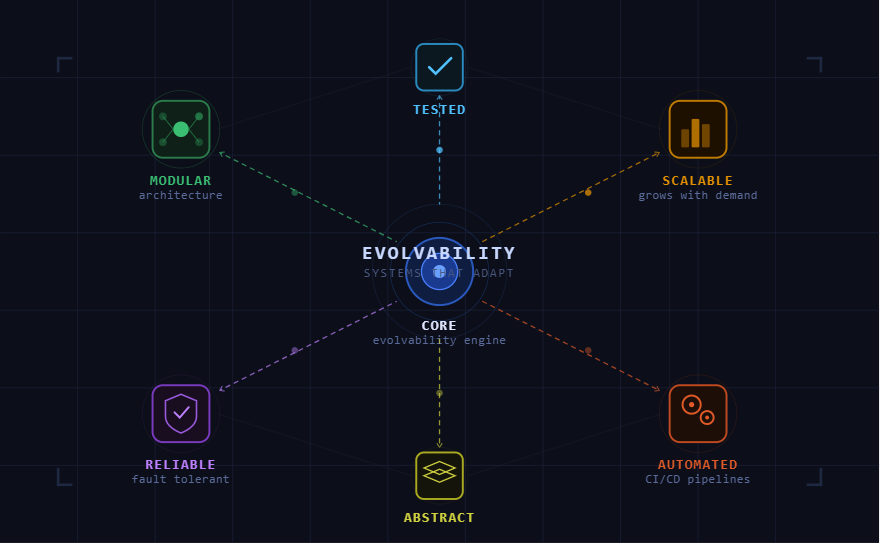
Highly evolvable systems share a recognizable set of properties. These aren’t optional extras they’re the engineering foundation that makes sustained adaptability possible.
Modular Architecture
Components are separated into clear boundaries with well defined responsibilities, so changes in one area don’t ripple unpredictably across the whole system.
Loose Coupling
Changes in one service or module don’t heavily impact others. Teams can deploy, update, and scale components independently.
Strong Testing Practices
Comprehensive automated tests allow teams to make changes confidently, catching regressions before they reach production.
Incremental Refactoring
Systems evolve continuously through small, safe improvements rather than through large, risky rewrites that concentrate risk.
Backward Compatibility
New changes don’t immediately break existing functionality or integrations, allowing gradual migration paths for consumers.
Clear Documentation
Engineers can understand system behavior and architecture without reverse engineering it from the implementation.
Deployment Automation
CI/CD pipelines, infrastructure automation, and monitoring make it safe and routine to ship changes reducing the risk of each individual release.
Observability
Good logging, metrics, and tracing let engineers understand system behavior in production and detect the impact of changes quickly.
The Risks of Systems That Cannot Evolve
When systems aren’t designed for evolvability, the consequences compound over time. What starts as slowing velocity eventually becomes an existential constraint on the business.
- Slower product development each new feature becomes increasingly costly to implement as the system’s complexity makes every change a risky proposition.
- Fear of making changes engineers avoid necessary improvements because the consequences are unpredictable, allowing problems to compound silently.
- Rising technical debt shortcuts accumulate until the debt load actively slows the team’s ability to deliver anything at all.
- Increased operational risk tightly coupled systems make it harder to isolate and contain failures when they occur.
- Loss of competitive agility while competitors ship and iterate, teams become consumed by maintenance rather than innovation.
The eventual result is almost always the same: a large scale rewrite that’s expensive, risky, and time consuming and which may produce a system with equally poor evolvability if the underlying engineering culture hasn’t changed.
Balancing Stability and Change
An evolvable system is not one that changes constantly and chaotically. Stability still matters a great deal. The goal isn’t maximum flexibility; it’s finding the right balance between a system that’s reliable enough to operate confidently and flexible enough to adapt when the moment demands it.
The Core Tension
Systems optimized purely for stability eventually become obstacles when change becomes unavoidable. Systems that change too freely become unpredictable. The best architectures hold both qualities at once stable interfaces, flexible internals, and a culture of deliberate, incremental improvement.
Reliability, Scalability, and Maintainability
Evolvability doesn’t exist in isolation. It’s inseparable from the three foundational qualities that define successful software systems in the long run.
Reliability
Systems must continue functioning correctly even when faults occur. Reliability enables confidence in making changes.
Scalability
Systems must maintain performance as demand grows. Scalability requirements often force architectural evolution.
Maintainability
Systems must remain understandable and operable by teams who didn’t build them. Maintainability is the prerequisite for safe change.
These qualities reinforce each other. A scalable system that can’t be modified becomes a bottleneck. A reliable system with poor operability becomes exhausting to run. A maintainable system without scalability can’t support growth. Strong engineering means treating all three as interconnected rather than separate concerns and understanding that evolvability is what ties them together over time.
Systems Must Be Built for the Future, Not Just the Present
Software systems are never truly finished. The environments in which they operate are constantly changing, and systems that cannot adapt eventually become obstacles rather than enablers of growth.
Evolvability is not an optional design goal; it’s a fundamental requirement for long term success. Architectures that prioritize modularity, simplicity, abstraction, and flexibility give teams the ability to respond to change with confidence rather than fear.
Organizations that invest in evolvable systems don’t just survive change they’re positioned to drive it. Instead of being constrained by rigid infrastructure or fragile architectures, they gain the ability to innovate continuously while maintaining the operational stability their users depend on.