






Figure 4.1
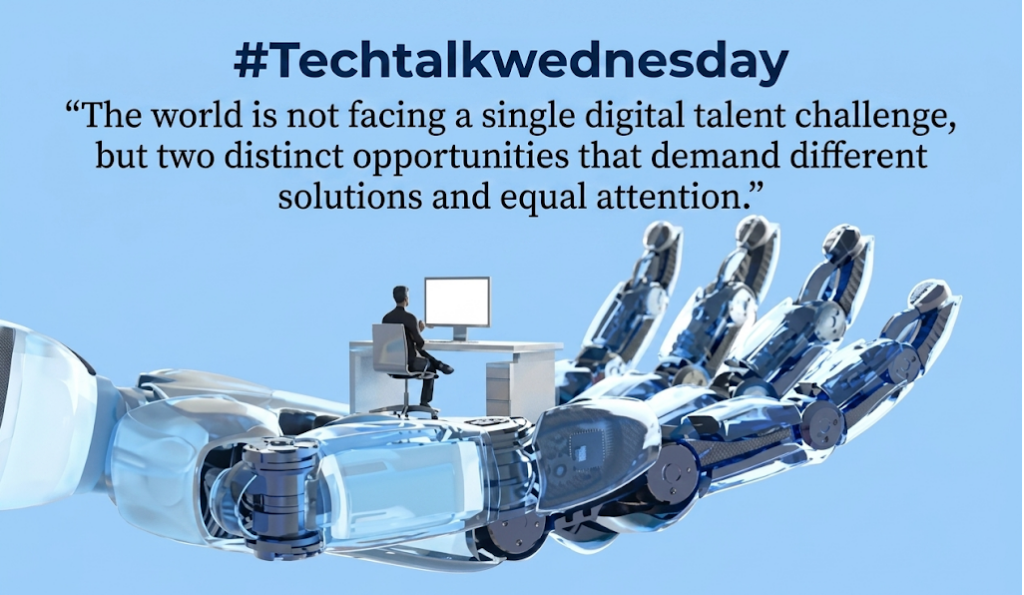
#Techtalkwednesday
For years, conversations around digital transformation have centered on one major goal: getting more people connected to technology.
Governments celebrate internet penetration rates. Telecom companies compete over data adoption. Tech companies expand into emerging markets with promises of connectivity, AI tools, cloud platforms, and smart devices. Across the world, digital access has become one of the defining indicators of modern progress.
But somewhere in the middle of this global push for connectivity, an important distinction continues to be ignored:
Access to technology is not the same thing as the ability to innovate with it.
And that distinction matters far more than most people realize.
A society filled with digital consumers but lacking digital creators will always struggle to shape the future of technology on its own terms. Being connected to the internet is important, but connection alone does not automatically create engineers, researchers, founders, AI scientists, cybersecurity professionals, or technology leaders.
The future of technology will not belong only to the countries or companies with the largest user base. It will belong to those building the systems, platforms, infrastructure, and intelligence powering the next digital era.
Access Solves Inclusion. Innovation Builds Power.
Digital access has transformed lives globally.
Today, billions of people use smartphones to communicate, learn, work, shop, bank, and participate in the global economy. Entire industries now exist because people gained access to digital tools and online platforms.
That progress matters.
Access creates opportunities for education, financial inclusion, healthcare delivery, e-commerce, and civic participation. It reduces barriers and allows more people to participate in modern economies.
But innovation requires something entirely different.
Innovation demands technical depth. It requires research ecosystems, engineering talent, experimentation, infrastructure, investment, and institutions capable of supporting long-term technological growth.
A person using AI tools is participating in technology.
A person building AI systems is shaping technology.
That difference defines economic power in the modern era.
The World is Entering a Builder Economy
The global technology industry is quietly shifting from a consumer economy into a builder economy.
Artificial intelligence, cloud computing, robotics, spatial computing, and advanced automation are no longer niche technologies. They are becoming the infrastructure layer for the next generation of business, education, governance, healthcare, and communication.
The countries and companies building these systems will determine how the future works.
This is already becoming visible in the growing competition around AI infrastructure and intelligent platforms. Major tech companies are no longer only competing over apps or devices. They are competing over ecosystems.
As explored in Why AI Browsers Could Become the Next Big Battle in Tech, browsers are evolving beyond simple tools for accessing websites. They are becoming intelligent assistants capable of understanding user intent, automating workflows, and reshaping how humans interact with information online.
The browser is no longer just a gateway to the internet. It is becoming an operating layer for AI-powered experiences.
At the same time, operating systems themselves are beginning to evolve. In another ChiidTech analysis, Why AI Operating Systems Could Redefine Personal Computing, we explored how AI-native operating systems could fundamentally change personal computing by turning computers into context-aware systems capable of predicting user needs, automating tasks, and adapting in real time.
These shifts reveal something bigger happening globally:
The next generation of technology will be built around intelligence, not just connectivity.
And that raises an important question for countries, institutions, and young professionals everywhere:
Who will build these systems?
Why Connectivity Alone is No Longer Enough
For over a decade, much of the global digital conversation focused heavily on access.
How many people are online?
How many smartphones are in circulation?
How many communities have broadband coverage?
Those metrics still matter, but they no longer tell the full story.
A country can have millions of internet users and still depend entirely on foreign technologies, foreign infrastructure, foreign AI systems, and foreign cloud providers. It can consume technology at scale while contributing very little to the systems driving it.
That imbalance creates long-term risks.
It limits economic competitiveness.
It reduces technological sovereignty.
It weakens local innovation ecosystems.
And it creates dependence on external platforms for critical digital infrastructure.
This is why technical education and innovation capacity matter more than ever.
The challenge today is not simply getting more people online. The challenge is creating more builders capable of shaping what happens online.
The Skills Gap is Becoming an Innovation Gap
Around the world, companies are already struggling to find skilled professionals in AI, cloud engineering, cybersecurity, data science, and advanced software development.
The rise of generative AI has accelerated this even further.
Businesses now need engineers capable of integrating AI systems into products. Governments need cybersecurity experts to secure digital infrastructure. Healthcare institutions need data specialists. Financial systems need cloud architects and AI governance professionals.
The demand for advanced technical talent is growing faster than most educational systems can respond.
And while AI tools are making technology more accessible, they are also raising the bar for technical understanding. Using AI is becoming easier. Building reliable AI systems is becoming more complex.
This is why countries investing heavily in innovation ecosystems are prioritizing more than digital literacy. They are investing in research labs, startup accelerators, STEM education, semiconductor development, cloud infrastructure, and AI talent pipelines.
Because the future belongs to those who can build, not just consume.
The Next Digital Divide Will Be About Creation
The first digital divide was about access.
The next digital divide will be about creation.
Some societies will primarily consume AI-generated products, automated systems, and digital services created elsewhere. Others will actively design, train, deploy, and govern the technologies shaping the future.
That divide will influence economic growth, global competitiveness, national security, education systems, and labor markets for decades.
This is why leadership matters at every level — governments, universities, private companies, startup ecosystems, and technology communities.
The goal can no longer stop at increasing digital participation alone.
The bigger goal must be increasing digital ownership, technical capability, and innovation leadership.
Building the Future Requires Both
None of this means digital access is unimportant.
In fact, access remains the foundation of everything else.
Without connectivity, people cannot participate in digital economies. Without affordable internet and devices, millions remain excluded from education, opportunity, and information.
But access without innovation creates dependency.
And innovation without inclusion creates inequality.
The real opportunity is building both together.
A digitally connected population creates demand for better services, smarter products, and stronger infrastructure. At the same time, strong technical ecosystems produce the engineers, founders, researchers, and creators capable of building those systems locally and globally.
The two are not competing priorities. They reinforce each other.
The countries, companies, and communities that understand this balance early will be the ones shaping the next era of technology.
Because the future of technology will not be defined only by who has access to digital tools.
It will be defined by who has the ability to create what comes next.
Read more technology insights, AI analysis, and digital transformation stories on ChiidTech.