







Figure1
In software engineering, the true cost of a system is rarely in its initial development; it lies in its ongoing maintenance. Long after a product is launched, teams continue to invest time and resources into fixing bugs, resolving incidents, adapting to new technologies, and evolving the system to meet changing user needs.
Maintenance is not a secondary concern; it is the dominant phase of a system’s lifecycle. Yet, it is often the most overlooked during the design stage. Many engineers find themselves frustrated when working on legacy systems, applications that are difficult to understand, fragile to modify, or built on outdated assumptions.
While every legacy system presents unique challenges, one thing is clear: poor design decisions today become tomorrow’s maintenance burden. The goal, therefore, is not just to build systems that work, but to build systems that remain easy to operate, understand, and evolve over time.
To achieve this, three core principles form the foundation of maintainable software systems: operability, simplicity, and evolvability.
Operability: Keeping Systems Running Smoothly
Operability focuses on how easy it is for teams to run, monitor, and manage a system in production. A well-designed system should empower operations teams to maintain stability without unnecessary complexity.
Key aspects of operability include:
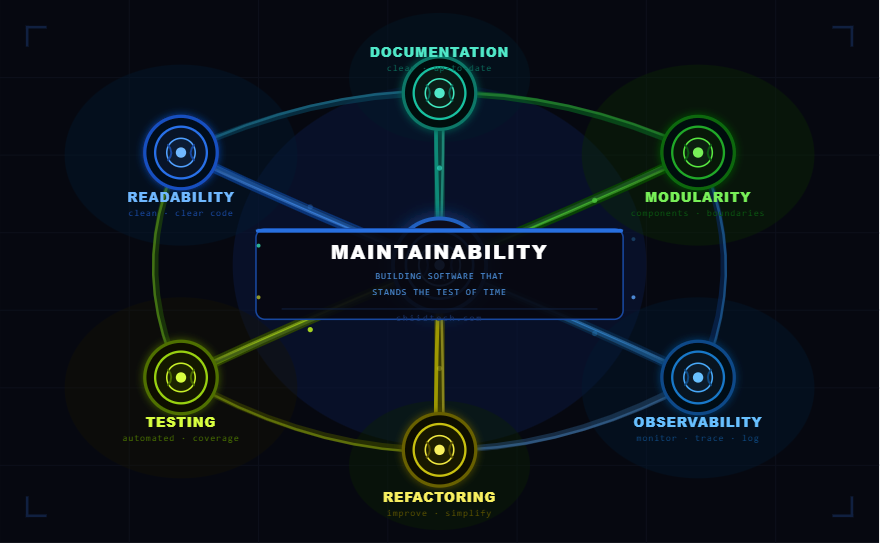
- Monitoring and Observability
Systems should provide clear insights into their behavior through logs, metrics, and traces. Engineers should be able to quickly diagnose issues without guesswork. - Automation
Routine tasks such as deployments, scaling, and backups should be automated to reduce human error and improve efficiency. - Incident Response
When failures occur, systems should support quick detection and recovery. This includes clear alerting mechanisms and well-documented runbooks. - Fault Tolerance and Recovery
Systems should be designed to handle failures gracefully, minimizing downtime and ensuring continuity. - Operational Simplicity
The easier it is to deploy, configure, and manage a system, the less likely it is to fail due to operational mistakes.
A system with strong operability reduces stress on teams, shortens downtime, and improves overall reliability.
Simplicity: Reducing Complexity for Better Understanding
Simplicity is one of the most powerful yet underestimated principles in software design. Complex systems are harder to understand, test, and maintain. Over time, unnecessary complexity becomes a major source of technical debt.
It is important to distinguish between user-facing simplicity and system simplicity. A system may have a simple interface but still be internally complex and difficult to manage.
Key strategies for achieving simplicity include:
- Clear Architecture
Use well-defined structures and patterns that make the system easier to reason about. - Modular Design
Break systems into smaller, independent components with clear responsibilities. - Avoiding Over-Engineering
Resist the temptation to build for hypothetical future needs. Focus on solving current problems effectively. - Readable and Consistent Code
Code should be easy to understand by other engineers, not just the original author. - Minimizing Dependencies
Reducing reliance on external libraries or tightly coupled components simplifies maintenance.
Simplicity improves onboarding for new engineers and reduces the likelihood of errors during development and maintenance.
Evolvability: Designing for Change
No system remains static. Requirements change, user needs evolve, and new technologies emerge. Evolvability also known as extensibility or modifiability-is the ability of a system to adapt to these changes with minimal friction.
A system that is difficult to modify quickly becomes obsolete or costly to maintain.
Key elements of evolvability include:
- Flexible Architecture
Systems should be designed to accommodate new features without major rewrites. - Loose Coupling
Components should be independent so that changes in one area do not break others. - Well-Defined Interfaces
Clear contracts between components make it easier to extend functionality. - Backward Compatibility
Changes should not disrupt existing users or integrations. - Incremental Development
Systems should support small, continuous updates rather than large, risky overhauls.
Evolvability ensures that a system can grow alongside the business and adapt to unforeseen requirements.
Additional Principles for Maintainable Systems
Beyond the core three, several supporting practices enhance maintainability:
- Documentation
Clear and up-to-date documentation helps teams understand system behavior and design decisions. - Testing and Quality Assurance
Automated tests (unit, integration, and end-to-end) ensure that changes do not introduce regressions. - Code Reviews
Collaborative reviews improve code quality and knowledge sharing. - Technical Debt Management
Regularly addressing shortcuts or outdated code prevents long-term issues. - Standardization
Using consistent tools, frameworks, and coding standards reduces complexity across teams. - Security and Compliance Awareness
Maintainable systems should also be secure and adaptable to evolving regulatory requirements.
The Reality of Legacy Systems
Legacy systems are often criticized, but they are usually the result of past constraints, evolving requirements, and rapid growth. What may seem like poor design today may have been a practical solution at the time.
Instead of viewing legacy systems as failures, it is more productive to see them as learning opportunities. They highlight the importance of designing systems with future maintenance in mind.
Conclusion: Designing for the Long Term
Maintainability is not a feature that can be added later. It must be built into the system from the beginning. By prioritizing operability, simplicity, and evolvability, engineers can create systems that are not only functional but also sustainable over time.
Key takeaways include:
- Most of a system’s cost lies in maintenance, not initial development
- Poor design decisions lead to long-term technical debt
- Operability ensures systems can be managed effectively
- Simplicity reduces complexity and improves understanding
- Evolvability allows systems to adapt to change
maintainable systems are those that serve both present and future needs, enabling teams to innovate without being held back by the past.