







Figure1
Data models shape the foundation of every software system. They influence how applications are designed, how engineers think about problems, how systems scale, and how efficiently information flows through an organization. Choosing the right data model is not simply a database decision it is an architectural decision that affects long term performance, maintainability, flexibility, and operational complexity.
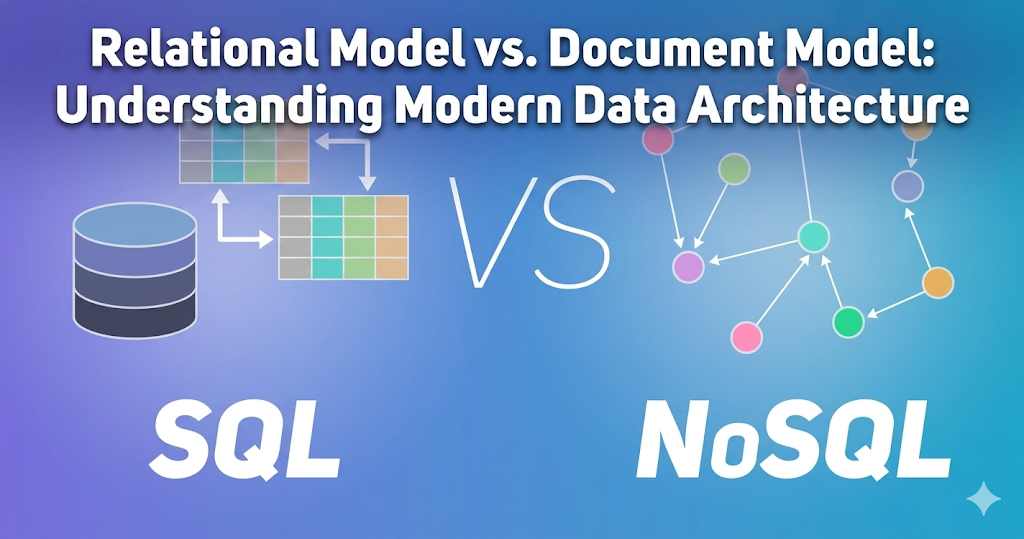
The relational model remains one of the most important concepts in the history of computer science. Introduced by Edgar F. Codd in 1970, it transformed the way organizations stored and managed information. Before relational systems became popular, developers often worked directly with rigid file systems and low level storage structures that were difficult to maintain and highly inflexible. The relational approach introduced a clean abstraction that separated how data was physically stored from how users and applications interacted with it.
This abstraction became revolutionary for businesses. Industries such as banking, airline reservations, payroll processing, inventory management, healthcare, and finance needed systems capable of storing large volumes of structured information reliably. Relational databases solved this challenge by organizing data into tables containing rows and columns, allowing engineers to model relationships between entities clearly and consistently.
Over time, relational databases evolved into powerful platforms capable of supporting highly transactional and mission critical systems. Technologies such as MySQL, PostgreSQL, and Microsoft SQL Server became central to enterprise infrastructure across the world. Their popularity was driven not only by reliability, but also by the ability to enforce strong consistency, maintain data integrity, and support complex relationships using structured query capabilities.
One reason relational databases remain highly relevant today is their ability to handle systems where correctness is essential. Financial transactions, payment processing systems, healthcare records, and enterprise resource planning platforms all require guarantees that data remains accurate and consistent even during failures or concurrent operations. Relational systems provide these guarantees through transactions, constraints, normalization techniques, and structured querying.
However, the growth of internet scale applications introduced new kinds of challenges that traditional relational systems were not always optimized for. Modern applications began handling massive amounts of semi structured and rapidly evolving data including:
- User generated content
- Social media activity
- Multimedia assets
- Event streams
- Real time analytics
- Nested application data
- Mobile and IoT data
As applications became more distributed and product requirements changed more rapidly, developers needed systems that allowed greater flexibility without constant schema migrations or rigid structural constraints.
This led to the rise of the document database model, a major category within the broader NoSQL ecosystem. Unlike relational databases, document databases store data in flexible document structures commonly represented using JSON or BSON. Each document can contain nested fields, arrays, and varying attributes, allowing applications to evolve without requiring a fixed predefined schema.
Platforms such as MongoDB, Apache CouchDB, and Firebase Firestore became widely adopted because they simplified development for dynamic and rapidly changing applications.
One of the biggest advantages of the document model is adaptability. In many modern applications, different users or entities may not share identical structures. For example, a social platform may store different types of posts, metadata, media formats, user preferences, and engagement data that evolve continuously as the product grows. A rigid relational schema may require repeated modifications and migrations, while a document based structure allows developers to extend and evolve the application more naturally.
The document model also aligns closely with modern distributed architectures and cloud native development practices. Many document databases are optimized for horizontal scaling, making them effective for applications with unpredictable workloads and large scale traffic demands. This has made document systems especially popular for:
- Content management platforms
- Mobile backends
- Real time analytics systems
- Recommendation engines
- Event driven applications
- AI powered platforms
- Large scale web services
Despite these strengths, document databases do not replace relational databases entirely. Instead, both models solve different kinds of problems effectively. Relational systems remain exceptionally strong where data relationships are complex and transactional consistency is critical. Document databases excel where flexibility, rapid iteration, and scalability are prioritized.
Modern engineering increasingly recognizes that there is no universal database solution. Many organizations now adopt a polyglot persistence approach, where different database technologies are used for different workloads within the same system. A company might use relational databases for payments and financial operations while using document databases for content feeds, analytics, or user activity storage.
This reflects a broader lesson in software engineering: every data model embodies assumptions about how data will be accessed, scaled, queried, and maintained. Some operations become simpler while others become more difficult. Some systems prioritize consistency while others prioritize flexibility or distribution.
Understanding these tradeoffs is essential for designing scalable and maintainable applications. As systems continue evolving toward distributed architectures, AI driven platforms, and cloud native environments, database selection becomes increasingly tied to long term architectural strategy rather than short term implementation convenience.
The most effective engineering decisions are rarely based solely on trends or popularity. They are based on understanding application requirements, scalability patterns, operational realities, and how systems will evolve over time.