






Figure1
Technology evolves in cycles. Many ideas that appear modern are often improved versions of older concepts redesigned for new challenges, larger scale systems, and changing application needs. The discussion between relational databases and document databases is one of the clearest examples of this pattern in software engineering.
Modern applications generate enormous amounts of data from users, devices, APIs, transactions, analytics systems, and cloud services. Because of this, choosing how data should be organized has become one of the most important architectural decisions engineers make. The debate is not simply about which database is “better,” but about understanding what type of problems each model solves most effectively.
One of the earliest major database systems was IBM Information Management System (IMS), created by IBM in the late 1960s. IMS used what became known as the hierarchical model, where data was stored in a tree like structure made up of parent and child records.
This structure worked extremely well for one to many relationships. A single customer could contain multiple orders, or a single blog post could contain many comments. Because related data existed together, systems could retrieve information quickly without performing expensive lookups across multiple locations.
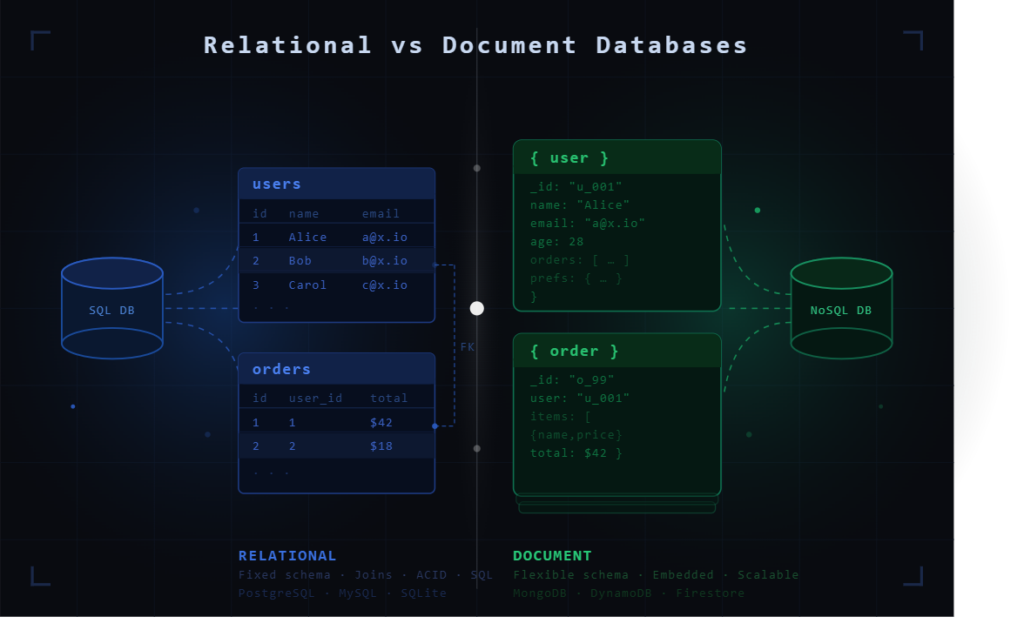
Modern document databases work in a very similar way. Systems such as MongoDB store information as nested JSON like documents, allowing related data to remain grouped together naturally. This makes development simpler for many modern applications.
However, challenges begin to appear when systems become highly interconnected.
Understanding the Main Architectural Tradeoffs
Data Duplication
One common issue in document oriented systems is duplication of information.
Imagine an e commerce platform where customer details are embedded inside every order document. If a customer changes their address or phone number, the application may need to update hundreds or thousands of separate documents.
This creates operational complexity because:
- Multiple records must remain synchronized
- Updates become slower and more expensive
- Inconsistent data can appear if some records fail to update
Relational databases solve this problem differently. Instead of duplicating customer information repeatedly, the customer exists in a separate table and orders simply reference that customer through relationships.
This reduces redundancy and improves consistency.
Manual Reference Handling
Document databases often require developers to manually manage relationships between pieces of data.
For example, if users, products, comments, and transactions all exist in separate collections, the application logic itself may become responsible for connecting and assembling the data.
As systems grow larger, this increases application complexity because developers must:
- Resolve relationships manually
- Handle missing references
- Manage consistency across distributed systems
- Write additional logic for related queries
Relational databases simplify this process through joins and structured relationships built directly into SQL querying systems.
Query Flexibility
Relational databases became dominant partly because they provide powerful querying capabilities.
Using SQL, developers can easily combine data from multiple tables, filter relationships, aggregate records, and analyze structured datasets efficiently.
For example:
- Finding all customers who purchased a product within a date range
- Combining transaction records with payment histories
- Generating financial reports across multiple datasets
These operations are often easier in relational systems because the database engine itself understands relationships between entities.
Document databases can still perform complex queries, but highly relational workloads may become more difficult and less efficient over time.
Why Document Databases Became Popular Again
Despite these tradeoffs, document databases solve several important modern challenges extremely well.
Flexible Schemas
Traditional relational databases require predefined schemas. If application structures change frequently, migrations can become operationally expensive.
Document databases allow developers to evolve data structures dynamically without redesigning entire schemas.
This flexibility is valuable for:
- Startups iterating rapidly
- Products with changing requirements
- User generated content platforms
- Experimental application features
Developers can add new fields or nested structures without restructuring the entire database.
Horizontal Scalability
Modern applications often serve millions of users across distributed cloud infrastructure.
Many document databases were designed with horizontal scaling in mind. Instead of relying on one extremely powerful machine, workloads can be distributed across multiple servers more easily.
This supports:
- Large traffic spikes
- Cloud native systems
- Distributed deployments
- Real time applications
- High availability architectures
Scalability became one of the biggest reasons NoSQL systems gained popularity during the growth of internet scale companies.
Natural Representation of Application Data
Document databases also align naturally with modern programming models.
Applications written in JavaScript, Python, Node.js, or modern APIs frequently exchange data in JSON format. Storing data as JSON like documents reduces the mismatch between application objects and database structures.
This simplifies development workflows and can improve engineering productivity.
Why Relational Databases Still Matter
Even with the rise of NoSQL systems, relational databases remain extremely important.
Systems such as:
continue to dominate industries where correctness and consistency are critical.
Relational databases are particularly strong for:
- Financial systems
- Banking platforms
- Enterprise software
- Healthcare systems
- Inventory management
- Transactional applications
These systems depend heavily on:
- ACID transactions
- Strong consistency
- Reliable relationships
- Structured data integrity
In these environments, correctness matters more than schema flexibility.
The Real Lesson from Database History
The return of document databases does not mean relational databases failed. Instead, it shows that software engineering continuously adapts to new requirements.
Different systems optimize for different priorities:
- Relational systems optimize consistency and relationships
- Document systems optimize flexibility and scalability
Modern architectures increasingly combine multiple database models together depending on workload requirements. This approach is known as polyglot persistence.
For example:
- A relational database may handle payments and transactions
- A document database may power user activity feeds
- A graph database may support recommendation systems
- An event streaming system may process analytics pipelines
The most effective architectures are rarely built around one technology alone.
The larger lesson is that every data model contains tradeoffs. Understanding those tradeoffs is far more valuable than following technology trends blindly. Strong engineering decisions come from understanding how systems behave under real world conditions and selecting tools that align with scalability, maintainability, operational complexity, and long term application goals.