







Figure1
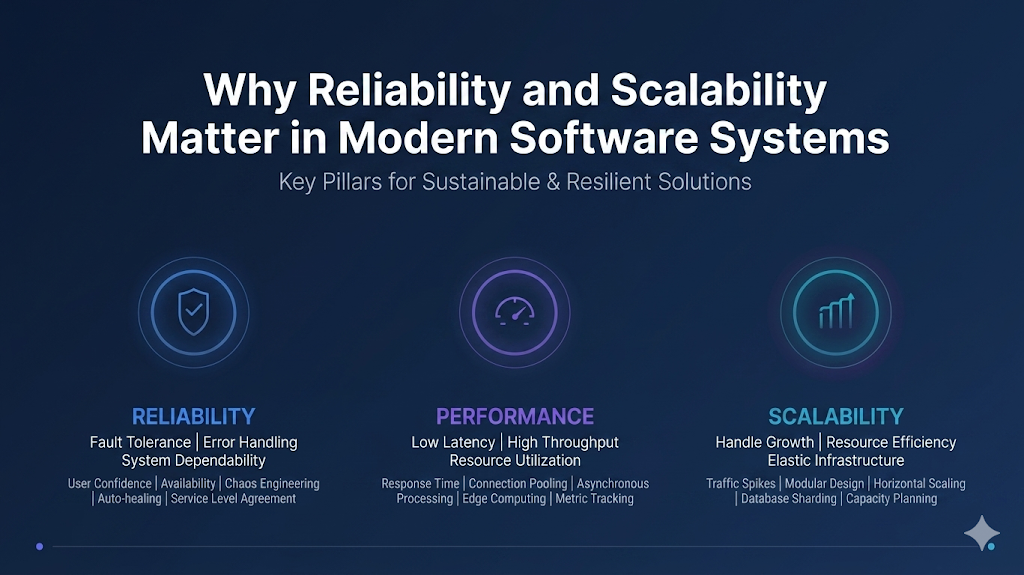
Why Reliability and Scalability Matter in Modern Software Systems
In today’s digital world, software systems underpin nearly every aspect of our personal and professional lives. From financial transactions and healthcare systems to social platforms and photo storage applications, users rely heavily on software to function consistently and securely. Because of this, reliability is no longer a luxury reserved for high-risk industries like aviation or nuclear energy.it is a fundamental expectation across all types of applications.
Understanding Reliability Beyond Critical Systems
Reliability in software engineering refers to a system’s ability to perform its intended functions consistently, without failure, under expected conditions. Traditionally, the term has been closely associated with mission-critical systems such as air traffic control or nuclear power monitoring, where failure can have catastrophic consequences. However, this narrow view no longer reflects reality.
Today, even seemingly “ordinary” applications carry significant responsibility. Consider business software used for financial reporting or operational management. A small bug in such systems can lead to incorrect calculations, misreported data, and potentially serious legal consequences. Beyond compliance risks, unreliable systems also reduce productivity, frustrate employees, and damage trust in internal processes.
Similarly, outages in e-commerce platforms can result in immediate revenue loss, especially during peak shopping periods. More importantly, they can harm a company’s reputation, driving customers toward competitors. Reliability, therefore, directly impacts both financial performance and brand perception.
The Human Side of Reliability
While technical failures are often measured in metrics like downtime or error rates, the human impact is equally important. Users place trust in software systems to safeguard their most valuable digital assets. For instance, imagine a parent who stores all photos and videos of their children in a digital application. If that data is suddenly lost or corrupted, the emotional impact can be devastating.
In such scenarios, reliability goes beyond system uptime. it includes data integrity, backup mechanisms, and ease of recovery. Many users may not have the technical knowledge to restore lost data, which means the responsibility lies heavily on the system designers to ensure robust safeguards are in place.
This highlights an essential principle: software developers and organizations have a duty of care to their users. Reliability is not just about preventing technical failures; it is about preserving trust and protecting user experiences.
Balancing Reliability with Cost
Despite its importance, achieving high reliability often comes with increased development and operational costs. There are situations where organizations may intentionally choose to compromise on reliability to optimize for speed or budget.
For example, when building a prototype for an unproven market, the primary goal may be to validate an idea quickly rather than to create a fully robust system. In such cases, investing heavily in fault tolerance and redundancy may not be justified.
Similarly, services operating on very narrow profit margins may limit infrastructure costs, accepting a certain level of risk in exchange for financial sustainability.
However, these trade-offs should always be deliberate and well-understood. Cutting corners without acknowledging the potential consequences can lead to significant problems later. The key is to make informed decisions, clearly identifying where reliability is critical and where some level of risk is acceptable.
Introducing Scalability: Preparing for Growth
Reliability alone is not sufficient if a system cannot handle growth. A system that performs well under current conditions may fail when demand increases. This is where scalability becomes essential.
Scalability refers to a system’s ability to handle increased load-whether that means more users, higher data volumes, or more complex operations-without compromising performance or reliability.
For example, a platform that works seamlessly with 10,000 users may struggle when that number grows to 100,000 or even millions. Similarly, systems processing moderate data volumes may encounter bottlenecks when faced with exponential growth.
It is important to note that scalability is not a binary attribute. It is not meaningful to label a system simply as “scalable” or “not scalable.” Instead, scalability must be evaluated in context:
- How does the system behave as user demand increases?
- What happens when data volume grows significantly?
- Which components become bottlenecks under stress?
Answering these questions helps identify potential weaknesses and informs strategies for improvement.
Strategies for Achieving Scalability
Designing scalable systems requires thoughtful planning and architectural decisions. Some common approaches include:
- Horizontal scaling (adding more machines or instances)
- Load balancing to distribute traffic efficiently
- Caching mechanisms for faster data access
- Database optimization (indexing, sharding, replication)
- Asynchronous processing for better responsiveness
Reliability and Scalability: A Shared Responsibility
Reliability and scalability are closely interconnected. A system that scales poorly will eventually become unreliable under increased load. Conversely, a highly reliable system that cannot scale will fail to meet future demands.
This means both must be considered together during system design. Engineers should anticipate growth and design systems that not only work well today but continue to perform effectively as conditions evolve.
The Cost of Ignoring These Principles
Failing to prioritize reliability and scalability can lead to serious consequences:
- Frequent system outages
- Loss of user trust
- Financial losses
- Operational inefficiencies
- Reputational damage
In competitive markets, users have little tolerance for unreliable systems. A single negative experience can be enough to drive them away permanently.
Conclusion
Reliability is no longer confined to high-risk industries, it is a baseline expectation for all software systems. Whether it is a business application, an e-commerce platform, or a personal data storage service, users depend on systems to work consistently and protect their information.
At the same time, scalability ensures that systems can grow alongside user demand without compromising performance or reliability. Together, these two principles form the foundation of modern software engineering.
Organizations must approach reliability and scalability with intention, making informed trade-offs where necessary but never losing sight of their responsibility to users. By doing so, they can build systems that are not only functional but also trustworthy, resilient, and future-ready.